
You Could Be Rich and Still Feel Poor. Here’s Why
Money is only one of the types of wealth, and most of us only track that one.
You hit the number. The salary you used to dream about. The title. The savings goal.
And somehow, the feeling you expected never fully showed up.
That’s not a personal failure. It’s a measurement problem — you’ve been tracking one kind of wealth while quietly running a deficit in the others.

1. Why Financial Success Doesn’t Always Feel Like Success
Money solves money problems. It doesn’t automatically solve loneliness, poor health, or the quiet feeling that your days don’t belong to you.
This is why you’ll meet financially comfortable people who feel stuck, and modestly-paid people who feel genuinely rich in their lives. The gap isn’t always about how much they earn — it’s about how many types of wealth they’ve actually built.
2. The Types of Wealth We Forget to Measure
Financial wealth is easy to track — it shows up in a number on a screen. The other forms of wealth are just as real, but nobody sends you a monthly statement for them.
Health you didn’t protect. Relationships you kept postponing. Skills you stopped growing. Time that quietly disappeared into other people’s priorities. None of it shows up as a warning — until it’s already been spent.
Research from the Harvard Study of Adult Development found that close relationships, more than money or fame, are what keep people happy through life.
3. The NextWise Wealth Audit
Here’s a simple way to see where you actually stand. Rate each area honestly from 1–10 — not where you wish you were, where you actually are right now.
Beyond money, there are five types of wealth worth tracking. The NextWise Wealth Audit asks one honest question for each:
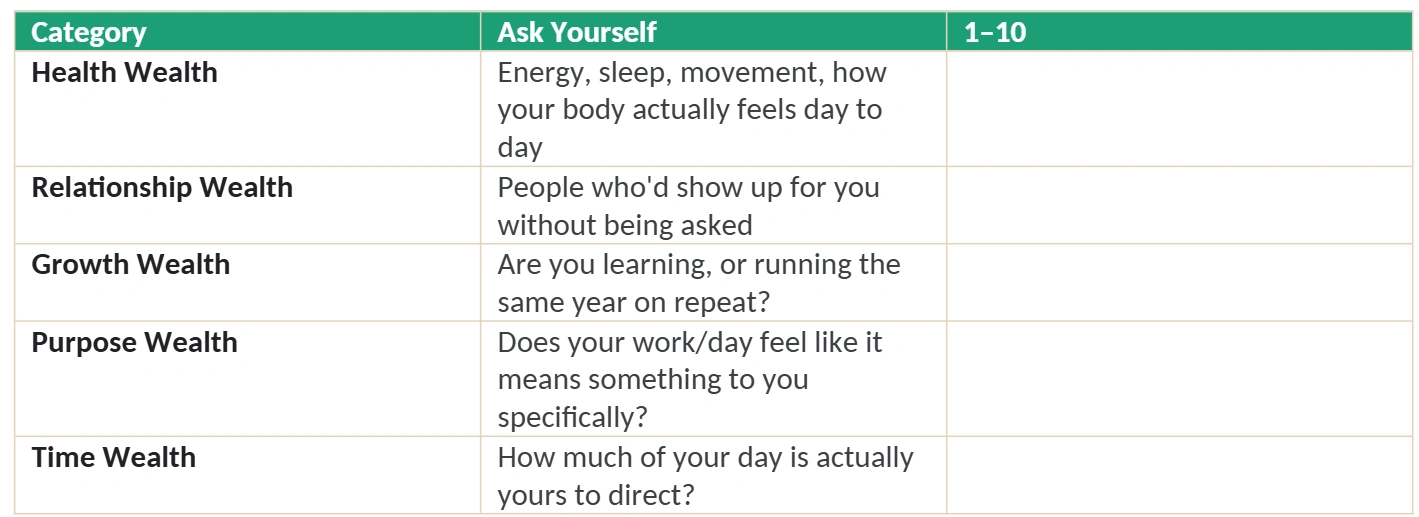
You don’t need a 9 or 10 everywhere. You need to know which score is lowest — that’s the one quietly running your life without your permission.
Here’s what this looks like in practice. Imagine someone who earns well and scores themselves like this: Health 4, Relationships 5, Growth 6, Purpose 4, Time 2. On paper, life looks successful. But the lowest score is Time, which means the real problem isn’t needing more money. It’s needing more control over their days. That’s the value of mapping your types of wealth: it shows you where to look, so you stop chasing a bigger salary to fix a problem a salary can’t solve.
If you’re also working on personal growth, our guide You Don’t Lack Confidence. You Lack Evidence. Explains how small, measurable wins can help rebuild confidence.

4. How to Grow the Wealth That Actually Compounds
You don’t need to fix all five categories at once. Pick your lowest score and start absurdly small.
Low Health Wealth: Don’t overhaul your life — add one 10-minute walk today.
Low Relationship Wealth: Message one person you’ve been meaning to reach out to, today, not “someday.”
Low Growth Wealth: Spend 15 minutes learning something that has nothing to do with work.
Low Purpose Wealth: Notice one moment today that felt meaningful — write it down. Patterns start with noticing.
Low Time Wealth: Say no to one thing this week that isn’t actually yours to carry.
If you’re finding it difficult to say no without feeling guilty, our guide on [You’re Not “Too Nice.” You’re Just Afraid to Say No.] can help you set healthier boundaries.
Small, unglamorous moves — repeated — are what actually compound here. The same way money does.
5. A Book Worth Reading If This Resonates
This idea — that real wealth has more than one currency — isn’t new. Author Robin Sharma explores a similar model in his book The Wealth Money Can’t Buy, if you want a deeper, book-length version of this thinking.
6. Final Takeaway
You’re not behind because your bank balance doesn’t match your effort. You might just be measuring the wrong currency.
Pick the one score from your Wealth Audit that’s lowest, and grow it by 10% this month — not to zero problems, just 10% better.
Real wealth was never one number. It’s five — and you get to decide which one needs you most right now.