
How to Start a Conversation When You Don’t Know What to Say
Learning how to start a conversation when you don’t know what to say can feel difficult, especially when you’re talking to someone for the first time.
Maybe they’re sitting next to you in class. Maybe they’ve just joined your workplace. Maybe you’re at a networking event and everyone seems to know someone except you.
You think:
“I should say something.”
Then your mind goes completely blank.
What should you say? What if they give you a one-word answer? What if the conversation becomes awkward?
If this sounds familiar, you’re not bad at talking to people. Starting a conversation is a skill, and you can improve it with practice. If you also want to become more comfortable talking to new people, read our guide on How to Talk Confidently to New People.
Research from the University of Chicago found that people expect talking to a stranger to be less enjoyable than sitting in silence, but those who did connect reported a more positive experience.
If you want to know how to start a conversation without feeling awkward, the good news is that you can practice it like any other skill.
The good news is that you don’t need a clever opening line or an impressive story.
You can start with something much simpler:
Notice what’s happening → ask something easy → listen to the answer.
Let’s look at how to start a conversation in real-life situations.

Table of Contents
Why You Don’t Know What to Say
The problem usually isn’t that you have nothing to say.
It’s that you’re trying to find the perfect thing to say.
When you’re about to talk to someone new, your mind might start asking:
- “What if they think I’m boring?”
- “What if I interrupt them?”
- “What if they don’t want to talk?”
- “What should I ask next?”
- “What if the conversation becomes awkward?”
When you try to solve all these questions before speaking, the first sentence starts feeling much more important than it really is.
You don’t need to impress the other person.
Your first goal is simply to give the conversation somewhere to go.
Knowing how to start a conversation gets much easier once you stop trying to sound clever.
Learning how to start a conversation is really about noticing more and worrying less.
How to Start a Conversation Naturally
Once you know how to start a conversation, the rest usually feels much easier.
When you don’t know what to say, look for three things:
- The situation
- Something specific about the person or topic
- Something you have in common
If you’re still learning how to start a conversation, begin with what you can see around you.
These give you a starting point without forcing you to invent a conversation from nothing.
Maybe you’re waiting for a class to begin. Maybe you’re at a conference. Maybe you’ve just joined a new workplace.
The situation itself can give you something to talk about.

1. Start With the Situation
Look around you.
Are you waiting for a class to begin? Sitting in a meeting? Standing in a queue? At a conference? Starting a new job?
The situation itself can give you something to talk about.
For example:
“Have you been to this event before?”
Or:
“Do you know when the presentation starts?”
Or:
“This place is surprisingly crowded today.”
These questions work because you’re talking about something both people can see or experience.
You don’t have to come up with a completely random topic.
Use what’s already happening around you.
2. Ask a Simple, Specific Question
Once you’ve opened the conversation, don’t worry about finding something brilliant to say next.
Ask a question that is easy to answer and connected to the situation.
Instead of:
“So… tell me about yourself.”
Try something more specific:
“What brought you to this event?”
Or:
“What kind of work do you do?”
Or:
“How do you know the host?”
Specific questions are easier to answer because the other person doesn’t have to figure out where to begin.
They also give you something useful to work with. Their answer can naturally lead to your next question or a related experience of your own.
The goal isn’t to ask question after question. It’s to give the conversation somewhere to go.

Specific questions are easier to answer because the other person doesn’t have to figure out where to begin.
They also give you something useful to work with. Their answer can naturally lead to your next question or a related experience of your own.
The goal isn’t to ask question after question. It’s to give the conversation somewhere to go.
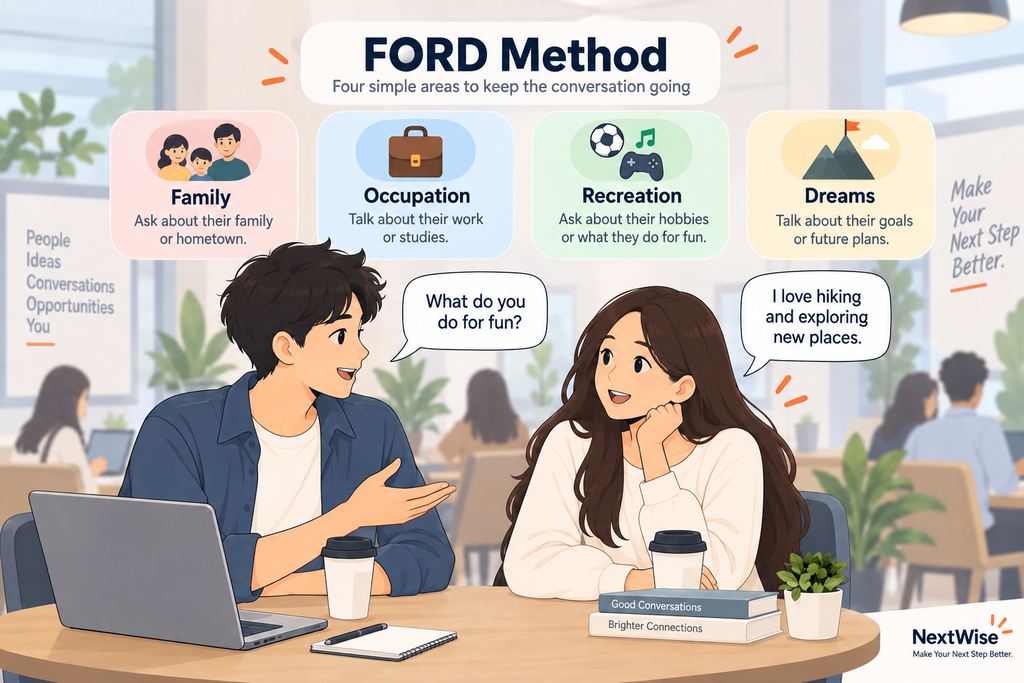
3. Use the FORD Method When You Run Out of Ideas
When your mind goes blank, you don’t need to invent a completely new topic. You can use a simple conversation framework called FORD.
FORD stands for:
- Family
- Occupation
- Recreation
- Dreams
These four areas can give you ideas when you don’t know what to ask next.
For example, if you’re talking to someone you just met, you could ask:
“What kind of work do you do?”
Or:
“What do you usually do for fun?”
Or:
“Have you been working on anything interesting lately?”
The important part is not to ask these questions like an interview.
Listen to their answer and pick something from it that you genuinely want to know more about.
For example, if they say, “I work in marketing,” you don’t have to immediately jump to another question.
You could simply say:
“Oh, interesting. What kind of marketing do you work on?”
That gives the other person something specific to talk about and gives you something to respond to.
The goal is not to memorize dozens of questions.
It’s to learn how to notice small details and use them to keep the conversation moving.
4. Listen Instead of Planning Your Next Sentence
Once the other person starts talking, your job is not to immediately think of the next perfect question.
Listen to what they actually say.
A common mistake is to spend the whole conversation preparing your next sentence while the other person is still speaking. When you do that, you can miss easy opportunities to continue the conversation naturally.
Instead, listen for something specific in their answer.
For example, if they say:
“I recently started working in marketing.”
You don’t need to jump to a completely different question.
You could simply say:
“That’s interesting. What kind of marketing do you work in?”
Or, if they mention something personal:
“I’ve been learning photography recently.”
You could ask:
“What got you interested in photography?”
Good conversations often come from paying attention to small details, not from having a long list of questions ready.
The more carefully you listen, the easier it becomes to know what to say next.

5. What If They Give Short Answers?
Sometimes you start a conversation, ask a simple question, and get a very short answer.
For example:
“Where are you from?”
“Chennai.”
That doesn’t automatically mean the person doesn’t want to talk.
They may be shy, distracted, tired, or simply unsure what to say next.
Instead of asking another completely unrelated question, give them an easy opportunity to continue.
You could say:
“Nice. Have you lived there for a long time?”
Or:
“I’ve been to Chennai a few times. What do you like most about living there?”
A short answer doesn’t always mean the conversation is over.

Give the conversation one or two natural chances to continue. If the other person still gives very short answers or doesn’t seem interested, it’s also okay to let the conversation end.
You don’t have to force every conversation to become a long one.
The goal is not to keep talking at any cost.
The goal is to create a comfortable conversation where both people want to participate.
6. Real-Life Situations
Starting a conversation can feel easier when you know what to say in common situations. You don’t need a perfect opening. Just use what’s happening around you as a starting point.
At a New Workplace
“Is this your first week here too?”
“How long have you been working here?”
At College or a Class
“Have you attended this class before?”
“What did you think about today’s session?”
At a Networking Event
“What brought you to this event?”
“Have you attended one of these events before?”
With Someone You See Regularly
“Hey, how has your week been?”
“I noticed you’re usually here around this time. Do you work nearby?”
The idea is simple: start with something natural, then listen to the answer. You don’t need to prepare an entire conversation in advance.
7. The Simple Conversation Formula to Remember
When you don’t know what to say, remember this simple five-step formula:
Notice → Ask → Listen → Follow Up → Share
1. Notice
Look at what’s happening around you or notice something relevant to the conversation.
2. Ask
Ask a simple, specific question based on what you noticed.
3. Listen
Pay attention to their answer instead of planning your next sentence.
4. Follow Up
Pick one detail from their answer and ask about it.
5. Share
Add something about yourself when it feels natural.
For example:
“You mentioned you enjoy hiking. Where do you usually go?”
“I’ve been wanting to try hiking too. Do you have a favorite place?”
You don’t need to memorize dozens of conversation starters. If you can notice, ask, listen, follow up, and share, you already have a simple framework for keeping a conversation going.

8. Common Conversation Mistakes to Avoid
When you’re trying to become better at conversations, it’s easy to focus too much on what you should say. But avoiding a few common mistakes can make conversations feel much more natural.
Trying Too Hard to Impress
You don’t need to prove that you’re interesting, funny, or knowledgeable. Trying too hard can make the conversation feel forced.
Asking Too Many Questions
A conversation shouldn’t feel like an interview. Mix questions with your own thoughts, experiences, or reactions.
Overthinking Every Pause
A short pause doesn’t mean the conversation is going badly. Give yourself and the other person a moment to think.
Changing the Topic Too Quickly
If someone shares something interesting, explore it before jumping to a completely different topic.
Forcing the Conversation
Not every conversation will turn into a long conversation. If the other person isn’t engaging, it’s okay to end the conversation politely.
The goal isn’t to have a perfect conversation. It’s to make the interaction feel comfortable and natural for both people.
9. A 5-Minute Conversation Exercise You Can Try Today
If you want to become more comfortable starting conversations, don’t wait until you feel confident. Practice with small interactions.
Try this simple five-minute exercise:
Minute 1 — Notice
Look around and identify one person or situation where a conversation could naturally happen.
Minute 2 — Start
Say something simple about the situation.
Minute 3 — Ask
Ask one specific, easy-to-answer question.
Minute 4 — Listen
Pay attention to the person’s answer instead of worrying about what to say next.
Minute 5 — Follow Up
Pick one detail from their answer and ask one natural follow-up question.
You don’t need to have a long conversation for this exercise to work.
The goal is to practice starting, listening, and responding without expecting yourself to be perfect.
Try this exercise once a day with small, low-pressure interactions. Over time, starting conversations can feel much more natural.
Final Takeaway
The more you practice how to start a conversation, the more natural it will feel.
Starting a conversation doesn’t require a perfect opening line or a naturally outgoing personality.
You can make it much easier by starting with what’s happening around you, asking simple questions, listening carefully, and following up on what the other person says.
That’s the whole idea behind how to start a conversation naturally: start small and stay curious.
Remember the simple formula:
Notice → Ask → Listen → Follow Up → Share
The more you practice these small interactions, the less pressure you’ll feel about finding the “right” thing to say.
You don’t need to become a different person to become better at conversations. You just need to practice taking the next small step.
Pingback: What to Say When a Conversation Becomes Awkward: 5 Simple Fixes