
Working Hard but Still Not Getting Promoted? 5 Things You Might Be Missing

If you’re still not getting promoted despite doing everything right, you’re not imagining it — something real is going on.
You finish your work. You take on extra tasks. You stay late when things get busy. You try to be the person your team can depend on.
So why does someone else get promoted while you’re still not getting promoted, even though you’re clearly putting in the work?
Here’s the uncomfortable part: working harder doesn’t always make you look ready for the next level. Sometimes, the problem isn’t how much you’re doing. It’s what your work tells people about what you can handle next.
Table of Contents
“Working hard matters — but career growth also depends on ownership, visible impact, good judgment, and showing that you’re ready for more responsibility.”
Hard Work Matters – But It Isn’t the Whole Story
Working hard is important. It shows commitment, discipline, and reliability.
But a promotion usually means more than doing your current job well. It means taking on greater responsibility, making better decisions, solving bigger problems, and creating value beyond your basic role.
So instead of asking:
“Am I working hard enough?”
Try asking:
“Am I showing that I’m ready for more?”
Here are five things worth checking.
1. You Complete Tasks, But Don’t Own Problems
There’s a difference between finishing a task and taking ownership of a problem.
Your manager says, “Please fix this customer issue.” You fix it and report back. That’s good.
But someone ready for more asks a different question: “Why does this keep happening, and what can we change so it doesn’t happen again?”
That’s ownership. When you’re ready for a bigger role, people need to see that you don’t only wait for problems to be assigned to you — you start looking for them yourself.
This is one of the most common, and most overlooked, reasons people are still not getting promoted.
2. Your Work Is Good, But Your Impact Isn’t Visible
You might be doing excellent work that nobody fully notices. That doesn’t mean you should brag — it means you should learn to communicate results clearly.
Instead of: “I worked on the monthly report.”
Try: “I simplified the monthly report and cut the prep time in half.”
The second statement explains the impact, not just the activity. Start keeping a simple record of:
● Problems you solved
● Projects you completed
● Time or money you saved
● Positive customer or team feedback
● Processes you improved
When promotion discussions happen, you’ll have something concrete to point to.

3. Show Your Thinking, Not Just Your Work
This is the pattern behind most stalled promotions: people give managers answers or updates, but not the reasoning behind them. Three moments give this away fastest.
When you need direction:
Weak: “What should I do?”
Strong: “I found two approaches. I recommend the first because it’s faster to test. Does that make sense?”
When something goes wrong:
Weak: Staying quiet and hoping the delay goes unnoticed.
Strong: “This may delay by one day — here’s what’s causing it, and here’s what I’m doing to fix it.”
When facing a hard decision:
Weak: “I don’t know. You decide.”
Strong: “Option A is faster but creates more work later. Option B is slower but more reliable. I recommend B.”
None of these require you to have every answer. They require you to show that you can think a problem through — that’s the signal that actually builds trust.
4. You Haven’t Shown You’re Ready for More Responsibility
Sometimes people wait for a promotion before they start behaving like someone ready for the next level. Try reversing that — look for small responsibility before the promotion:
● Lead a small project
● Help a new team member
● Improve an existing process
● Take ownership of a recurring problem
● Present your team’s work
● Volunteer for something slightly outside your usual role
You don’t need to take on everything — choose one and do it well. The goal isn’t to prove “I can do more work.” It’s to show “I can handle more responsibility.”
5. You’re Working Hard — But Not Deliberately Building Your Career
This is an easy trap. You become reliable, so you keep getting more work. But more work doesn’t automatically mean more career growth.
Ask yourself: “What evidence shows that I’m ready for the next level?“
Maybe you’ve:
- Solved a problem that kept coming back
- Improved a process
- Taken ownership of an important task
- Helped a teammate become more effective
- Saved time or reduced mistakes
- Learned a skill that your next role requires
Keep track of these wins instead of letting them disappear into your daily workload.
The goal isn’t to collect more work. It’s to build a clear record of the value you create and the responsibility you can handle.
And if you don’t have much evidence yet, that’s okay. You now know what kind of opportunities to look for.
If you’re also thinking about what can move your career forward beyond simply working harder, read 3 Things That Can Move Your Career Forward Beyond Hard Work.
If you’re still not getting promoted despite doing all of this, it might simply be about timing or organizational limits — not your ability.
This pattern is common enough that career experts at The Muse have written extensively about it — worth a read if you want more detail.

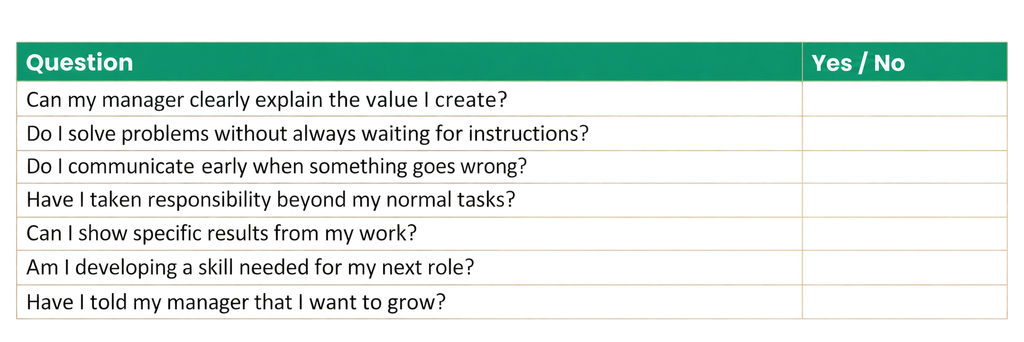
The NextWise Promotion Readiness Check
Take five minutes and answer these honestly. You don’t need seven “yes” answers — the goal is to find the one or two areas that need your attention most.
What to Do If You’re Working Hard but Still Not Getting Promoted
Don’t immediately assume your manager doesn’t appreciate you. Start with a conversation.
Ask: “I want to grow into a bigger role. What specific skills or results would you need to see from me before considering me for the next level?”
That’s a much better question than “Why haven’t I been promoted?” — then listen carefully. If they mention a skill, work on it. If they mention results, start tracking your impact. If they mention leadership, look for ownership opportunities.
And if you’ve consistently delivered, developed your skills, communicated your goals — and still see no realistic path forward, that information matters too. Sometimes the issue isn’t your effort. There may be limited opportunities or organizational constraints at play.
If you’ve tried everything above and you’re still not getting promoted, it’s time for a direct conversation instead of more guessing.
Final Takeaway
Working hard is valuable. But working hard should be building something.
Build trust. Build visible results. Build the ability to solve bigger problems.
You don’t need to work twice as hard. You need to make your hard work count toward your next step.
You don’t need to work twice as hard — you need evidence that answers the real question behind why you’re still not getting promoted.